How to Get Cited in Google AI Overviews: Lessons From 3 Real Citations
Google's AI Overviews now sit above the classic blue links for a growing share of searches. If your page is not one of the sources the overview cites, you can rank on page one and still lose the click. That is why AI Overviews SEO, also called answer engine optimization (AEO) or generative engine optimization (GEO), is now part of every SEO plan I build.
Over the last few months, three pages I worked on were cited as sources in AI Overviews: an education group in the UAE, an online pharmacy in Egypt and a B2B valve supplier in Egypt. Different languages, industries and markets. The pages had a lot in common, and that is what this guide is about.
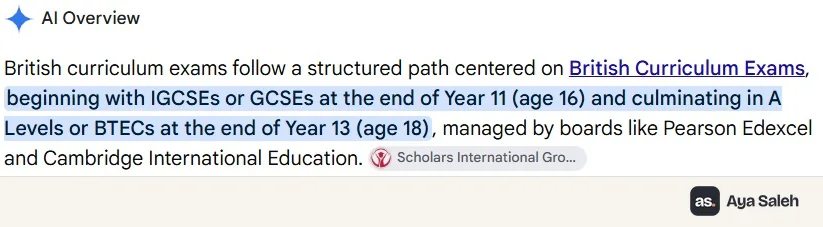
The three citations
| Search | Site | Market |
|---|---|---|
| british curriculum exams | sigeducation.com | UAE |
| سعر فورفلوزين 10 | elsaeedpharmacyeg.com | Egypt (Arabic) |
| balancing valves HVAC systems | ecie-eg.com | Egypt (B2B) |
For Scholars International Group, Google's AI features went from about 20 impressions a day to more than 450 a day by late October 2026, with 7.57K impressions in three months. You can track the same thing in Search Console under Performance → Generative AI features, and see both clients' charts in my AI search results.
1. Answer the question in the first two sentences
In all three cases, the sentence Google lifted into the overview was a direct, self-contained answer placed near the top of the section.
For the education page, the overview quotes the path from IGCSEs or GCSEs at the end of Year 11 (age 16) to A Levels or BTECs at the end of Year 13 (age 18). For the B2B valve supplier, it quotes what balancing valves do: regulate and distribute chilled or hot water evenly across terminal units, risers and branches.
Neither sentence needs the rest of the page to make sense. That is the test I use now: if you cut the first two sentences under a heading out of the page, do they still answer the heading?
2. Use headings that match the sub-questions (and the AI Overview's own structure)
AI Overviews usually answer the main question, then break it into parts: types, stages, benefits, prices, when to use it. Pages that already follow that shape are easier to cite.
Before writing, I list the sub-questions from People Also Ask and from the overview itself, then turn each one into an H2 or H3. You can see it in the titles of the cited valve pages: "Balancing Valves in HVAC Systems: Types, Benefits" and "Valve Sticking Problems: Causes, Symptoms, Troubleshooting". The title promises the exact parts the overview wants to show.
3. Be specific: numbers, ages, prices, years
Vague copy rarely gets quoted. Specific facts do: an age, a year group, a price in EGP, a pack size. The pharmacy page cited for a price search states the official price and the number of tablets in the pack, and that is the exact line the overview shows.
If a fact can change, add the year to the heading or the first line, and update it. Freshness matters even more when the answer is a number.
4. Rank first, then get cited
The valve page ranked #1 and the pharmacy page ranked #2 for the same searches they were cited for. In my experience the overview picks its sources mostly from pages Google already trusts for that query.
So the classic work still comes first: one keyword per page (a keyword cannibalization audit shows where two pages compete), a clean title and meta description you can test in the SERP preview tool, internal links from related pages, and a few relevant backlinks.
5. Build a small cluster around the page
A single page can be cited on its own, but I get more consistent results when the page sits inside a small cluster: three or four supporting articles that link back to it with descriptive anchor text. That tells Google which page is the main answer for the topic.
6. Make the page easy for machines to read
- One clear H1 that matches the search.
- Short paragraphs, real lists and tables where the content is a list or a table.
- Article or FAQ schema where it fits the page. You can build it in a minute with my free schema markup generator.
- No key answers hidden inside images, tabs or sliders.
A checklist you can use today
- Pick a page that already ranks in the top 10 for a question-type search.
- Rewrite the first two sentences under each heading so they answer the heading on their own.
- Add the sub-questions from People Also Ask as H2s.
- Add one specific number or fact to each section.
- Link to the page from two or three related articles.
- Watch Generative AI features in Search Console for the next 4–6 weeks.
AI Overviews change often, and no one can guarantee a citation. But pages that answer clearly, specifically and early give Google the easiest possible reason to quote them.
If you want this done on your site, see my AEO & GEO service or SEO content service.
More articles
Keyword Cannibalization Audit: A Step-by-Step Process
The exact process behind a 93-URL audit for a New York clinic, from finding conflicts to rolling out 40 fixes.
Technical SEOHow to Clean Up a Casino Spam Hack in Google: A WordPress SEO Recovery Guide
Finding about 400 spam URLs, returning the right status codes and getting a hacked site clean in Google.
سيو المتاجر · عربيسيو المتاجر الإلكترونية في مصر والسعودية: دليل عملي من متاجر حقيقية
خطوات عملية لتصدر جوجل بمتجرك في مصر والسعودية، مع نتائج من متاجر حقيقية.